There's a phenomenon that's kind of under the radar, at least it is for me. I guess if you watch "Glee," which I don't, you've probably caught wind of it. It's called a flash mob.
In Glee, in musicals, and now suddenly in real life, groups of people spontaneously come together to sing and dance. While I love a good musical, I love good music with dancing. The cause of that might be that I'm entirely too self-conscious to let myself go and dance, so I have to get the joy of that vicariously, watching others do it. But I can sing (not as well as I used to so I keep it kinda low), and I can sing along with the music and maybe fantasize that I'm flying and floating along with all those beautiful people.
Flash mobs are just groups of people who come together on an agreed-on cue, do some performance of some kind, and disperse. Boom, done, that's it. No passing of hats, no playbills or announcements. If you're there to catch it, good for you. If not, look for it on YouTube.
Seriously. Look for it on YouTube. There are so many flash mobs, from small and relatively amateur all the way up to gigantic and very professional, with lots of cameras there to capture the moment and good recordings so it doesn't sound like it was recorded with a cell phone.
Norris Little Theatre did one for Independence Day. It was a little too small, in my opinion, to have the impact that it could have had. Too bad and I have no one to blame for it but myself - I played a part in the last play, and I survived a few Arthur Murray courses. I could maybe have held it together long enough to do one little flash mob.
Then there's the gigantic flash mob that involved the Black Eyed Peas, Oprah, and one seemingly hyperactive fan at the front of the crowd. There's Oprah filming the performance and the crowd and the one ecstatic fan. Then suddenly more fans around her are dancing. Then more.
And then, amazingly, the entire crowd is dancing. They're all in on it. The only one who didn't know what was coming, apparently, was Oprah. A nice sendoff, really, for the lady who kept surprising her audience members with impressive gifts: here's one back for you.
Sweetie sometimes gets woken up in the middle of the night. More often than not, it's the cat who sleeps curled up on my shoulder, stretching and walking across Sweetie's belly. Nice kitty. So there she was wide awake and cranky at the cat. She stumbled downstairs and fired up Youtube. What she found, she loved.
Here's a few Sweetie recommended to me:
Frozen Grand Central Station
Do Re Mi in Antwerp
James & Abby's Wedding This one might be my favorite.
What's the point of a flash mob? Well, it's fun. And it sure looks like the people watching are having fun. And who doesn't want to have fun? If you have the option to give somebody a boost, isn't that a great thing to do?
Sure it is.
Okay, I guess I should participate in the next flash mob.
Monday, July 11, 2011


Sunday, July 10, 2011
Jumping Spider: Lunch
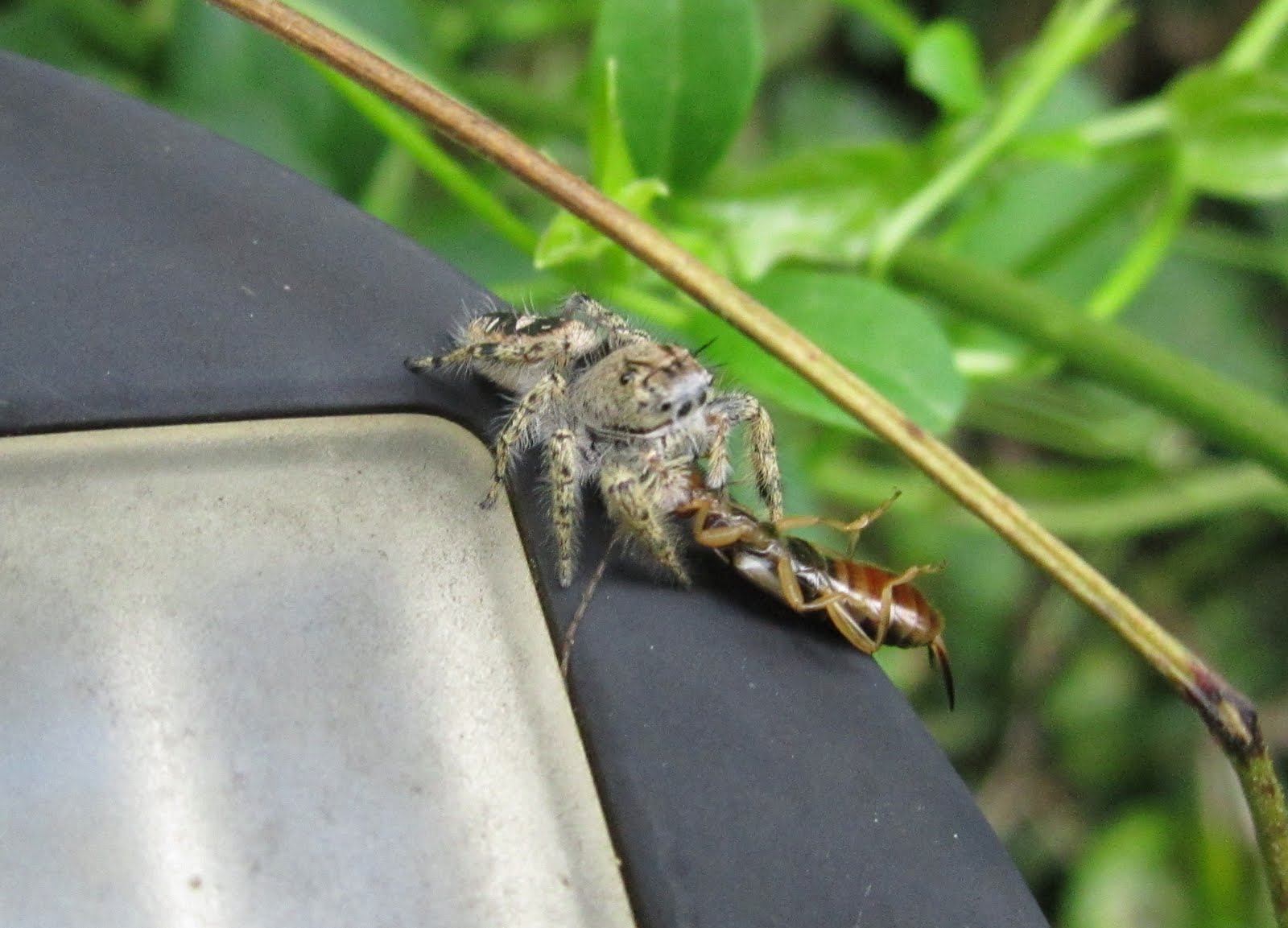
Sweetie's camera, a Canon Powershot A2200, is great for macros. Son #2 had it out in the yard on Saturday morning and found this:


Phidippus Mystaceus, snarfing an earwig
You really need to click the image and zoom in for the full effect. You think this little guy is cute now, wait until he fills the entire screen.
Jumping spiders have a few interesting qualities that make them more engaging than other spiders. First of all, they're hunters. They don't spin a web and wait for something to blunder along - usually me, on my way to the car. They go out in search of their food, and get it. So you never see one just sitting around. If he's sitting, he's thinking about where he's going next.
And their eyes, their many many eyes, are more aware of you than the myopic little specks on the webspinners. The jumper's eyes are big and almost personable. Move around close to him even up to several body lengths away, rather (his body lengths, not yours) and he watches you. He watches you, and you can see that he's watching. His body moves up and down, tracking things that are close enough to be worth noticing. If the light is right and your eyes are good enough, you can see tiny flickers of light coming from the jumper's eyes. That's not a flicker of light like you might think, it's a reflection from inside the spider's eyes. The eyes are so big in relation to the rest of the head that the lenses are completely fixed, but the spider can steer the retinas from inside to achieve better focus and keep things in the narrow field of view. He really can look around and watch what he finds interesting.

This one is sitting on a crank wheel that's an inch thick. So he's maybe a quarter-inch long.
Here's that first one again, enjoying his meal
Jumpers comprise the largest portion of the spider family, with over 500 different species. They're found pretty much everywhere except Antarctica, even on the slopes of Everest.
Okay, Sweetie's taking her camera battery out of the charger. Looks like she's off to find more spiders.
Thursday, July 7, 2011
International Nude Day
Hands off those buttons! We're not there yet.
International Nude Day - also called National Nude Day in New Zealand - is July 14. That's a week off, so you've got some time to prepare, to psych yourself up.
Time to choose what to wear. Ha ha ha.
My mom will probably throw her hands up in frustration at this. She didn't raise me to be running around in my birthday suit. Oh well, Mom. You did your best.
I haven't gotten up to much in the way of naked shenanigans, to be completely frank. There was a memorable excursion into an especially deep snowfall one January night when I lived in a house whose yard had considerably more privacy than where I live now. Getting in touch with my inner Finn, I soaked in as hot a tub as I could stand until I couldn't stand it any longer, then dashed outside to roll in the snow.
That was both a shock and a revelation. After a few seconds of rolling in the snow, I had to dash back inside, but that brief exposure had wrenched my body temperature back to neutral. I've gotten similar results from a jump from the hot tub to the in-ground pool at a condo in Gatlinburg on my birthday, which was awesome in that my mom got to witness that (a distant "Oh!" of dismay as we jumped into the pool told me Mom had seen us leaping into the cold pool. Don't anybody leer, it was in a public place. We had our swimsuits on.) and could only shake her head at our insanity. The beauty of the hot tub was that we could heat up again and jump in again.
The next morning we did it again, but we had to crack the ice off the pool before jumping in. It was that cold.
So what could you do on International Nude Day? Well in many parts of the States, not much. Anti-nudity laws on the books mean whatever you want to do, you're going to have to do it at home or in a relatively secluded location if you don't want not-like-minded individuals complaining to the local constabulary. Getting arrested is bad enough, getting arrested naked is just awful.
I'm guessing. Never been arrested, myself.
But back to the point. Nude beaches, nude resorts, your own back yard if you don't have neighbors close by. The bedroom, the covered porch. Relax and read a book. Feel the wind in your toes as you read. Not the newspaper, I find the news troubling enough that I prefer to have all my armor on if I have to see what's up with the world.
There's a spot on the shore of the lake around here that's perfect for after-dark skinny dipping. It's an excellent spot for a quick dip but for one little problem:
July 14 is a Thursday. Skinny-dipping feels like such a weekend thing. Can't we push it back one more day?
International Nude Day - also called National Nude Day in New Zealand - is July 14. That's a week off, so you've got some time to prepare, to psych yourself up.
Time to choose what to wear. Ha ha ha.
My mom will probably throw her hands up in frustration at this. She didn't raise me to be running around in my birthday suit. Oh well, Mom. You did your best.
I haven't gotten up to much in the way of naked shenanigans, to be completely frank. There was a memorable excursion into an especially deep snowfall one January night when I lived in a house whose yard had considerably more privacy than where I live now. Getting in touch with my inner Finn, I soaked in as hot a tub as I could stand until I couldn't stand it any longer, then dashed outside to roll in the snow.
That was both a shock and a revelation. After a few seconds of rolling in the snow, I had to dash back inside, but that brief exposure had wrenched my body temperature back to neutral. I've gotten similar results from a jump from the hot tub to the in-ground pool at a condo in Gatlinburg on my birthday, which was awesome in that my mom got to witness that (a distant "Oh!" of dismay as we jumped into the pool told me Mom had seen us leaping into the cold pool. Don't anybody leer, it was in a public place. We had our swimsuits on.) and could only shake her head at our insanity. The beauty of the hot tub was that we could heat up again and jump in again.
The next morning we did it again, but we had to crack the ice off the pool before jumping in. It was that cold.
So what could you do on International Nude Day? Well in many parts of the States, not much. Anti-nudity laws on the books mean whatever you want to do, you're going to have to do it at home or in a relatively secluded location if you don't want not-like-minded individuals complaining to the local constabulary. Getting arrested is bad enough, getting arrested naked is just awful.
I'm guessing. Never been arrested, myself.
But back to the point. Nude beaches, nude resorts, your own back yard if you don't have neighbors close by. The bedroom, the covered porch. Relax and read a book. Feel the wind in your toes as you read. Not the newspaper, I find the news troubling enough that I prefer to have all my armor on if I have to see what's up with the world.
There's a spot on the shore of the lake around here that's perfect for after-dark skinny dipping. It's an excellent spot for a quick dip but for one little problem:
July 14 is a Thursday. Skinny-dipping feels like such a weekend thing. Can't we push it back one more day?
Wednesday, July 6, 2011
Thinking About Cars: Chevy Citation
Back in the 1980s - it might have been 1980 exactly - I went away to a Boy Scout camp for a couple of weeks. It was an okay campout but not my favorite. In fact, in retrospect it's my experience with Boy Scouts that pretty much ruined camping for me. Not that I ever saw much attraction to camping, here I have a perfectly good house with refrigeration, plumbing, electric lights and a door on the bathroom. You want me to give all that up why? That last question never got answered to my satisfaction.
Anyway. Scout camp, two weeks. Get back and drag my sorry self and my gear toward the...car? That's not the family car.
Up until this point the family car had been few different things. There had been an Opel Kadett from 1967 and a SAAB 96 from 1970. The Opel was a tiny little two-door sedan, conceived in its present form as GM's answer to the Volkswagen Beetle. The SAAB was a slightly larger two-door sedan, and it looked like nothing else. I have compared it to a VW Beetle, if the Beetle were made of Play-Doh and allowed to stretch and smooth out a bit on a warm day, but that's really not fair.
So I was expecting a ride home in either of these cars. A dinky little German econobox or a slightly less dinky Swedish...hmm...I've never known exactly what kind of car you'd call the 96. Anyway.
Dad led me to a Chevy Citation. I was very excited.
By now the Citation isn't well remembered. It had a few bad recalls that tainted its image, and it was not powerful, and none of its problems were well addressed by GM. But at the moment it was an utterly new car, beautifully silvery gray and exuding that indefinable aura of freshly minted wheels. It smelled new, of course. And wonder of wonders, I got my own door. A four door car, at last.
I'd been hearing ads for the Citation on the radio, and seeing them on the TV. GM went all-out with the Citation's ad campaign, educating the public on just how good front wheel drive is for the average driver, how much roomier it makes the car, et cetera. From the back seat, I could see they had a point. There was still a hump between the rear foot wells but nothing like what was in the Opel. The car seemed outlandishly wide, but after years in the back seat of compact European cars, anything would have felt big.
In later years I discovered the Citation, though billed as a compact car, had more interior room than a Cadillac Coupe de Ville. I believed it.
The trunk was crazy. It was huge, with a flat floor and access into the interior through a seatback that folded down and, really weirdly, I didn't see any exposed metal back there. The old cars were pretty bare in the trunk, but the Citation presented you with more carpet. It was a finished space. I felt almost guilty to toss my grungy backpack and crusty boots in there.
It didn't take long for some of the charm to wear off. Dad had chosen a car that had neither air conditioning nor a radio. Eventually we had a radio installed, but in the Citation the radio slot was vertical. I had never seen that before, and I still don't recall if it required a special radio or we simply got used to reading the dial sideways. But air conditioning simply never appeared, and that stunk. The DC area gets pretty hot and muggy in summer, and when we took long road trips in that car we were tearing along at interstate speeds with all the windows down. Subsequent research suggests that the fuel economy doesn't suffer as much from running the air conditioning as it does with running with windows down. And of course the rear windows didn't roll all the way down anyway.
The rear seat had a few other unpleasant surprises. In typical in-town trips you might not ever notice, but on long highway rides you'd discover that the seat belts takeup reels didn't do anything but take up. When Mom noticed this she stopped calling them seat belts and started calling them anaconda belts. Exhale and the seat belt would cinch up a tiny bit. Shift a little, cinch up a little. Eventually the seat belt had a tight grip on you and you couldn't move another inch, at which point you had to release it, let it all the way into its reel to reset, and start over.
The Citation was saddled with the Iron Duke engine. The Duke isn't a bad engine on its face but it had several features that made it less than stellar. For starters at 2.5l displacement it was a biggish four-banger, but for all that displacement only yielded 88 horsepower. So for all of your gritted-teeth tolerance of the big four's vibration and rocking, you got very (very) modest power for your pains. You could opt for the 2.8l V6 which was good for 40hp more, but I don't think my Dad has owned anything but a four-cylinder car in the last 40 years.
The Duke eventually morphed into what was called the Tech IV engine (ridiculed as the Low Tech IV) and finally saw yeoman duty as the base engine in the Chevy S-10 pickup. The Duke wasn't all frowns: back in the day you could build a Duke with power out the wazoo if you didn't mind wrenching your own: the Duke is a Pontiac design, and Pontiac was at the time the GM brand with the most sporting image and hardware. The Super Duty Four started with a heavier-duty Duke block with thicker castings, bigger bearings and a solid forged cranked to replace the lighter duty economy minded hardware. Choose your parts right and you could build a Duke that would displace over 3.0 liters, pump out a mighty 300 horsepower, and shock the daylights out of anybody looking into the engine bay and seeing an Iron Duke under the hood. At the time it was even a halfway economical thing to hotrod, since there's some parts commonality between the Duke and other Pontiac engines of the day. The Super Duty Four is still available from Kansas Racing Products.
But we didn't have the Super Duty Four. We had a Duke. It got the car down the road. It ran through a four-speed manny tranny, which also got the car down the road...until the time one of the shifter cables snapped. Dad shared that story: "Well, the shifter just laid right down. Flop. I waggled it this way and that until I felt it go into a gear and I thought, hey, maybe I can get somewhere. Turned out to be second gear and I figured that would probably suffice. Drove it all the way to the shop in second gear. Took about half an hour to go five miles."
I liked the Citation in spite of its foibles. As much as I like the Citation, I liked the Citation X-11 even better. With vastly superior handling and a functional active hood induction system, the first X-11 spanked the contemporaneous European sport sedans with its power and handling. It was surprisingly quick and nimble and was a force to contend with on the rally circuits. If I had the parking space and could have a Citation today, I would. If I could have an X-11, I most definitely would. Though history has been unkind to its memory, I liked the Citation. It was a good car.
Anyway. Scout camp, two weeks. Get back and drag my sorry self and my gear toward the...car? That's not the family car.
Up until this point the family car had been few different things. There had been an Opel Kadett from 1967 and a SAAB 96 from 1970. The Opel was a tiny little two-door sedan, conceived in its present form as GM's answer to the Volkswagen Beetle. The SAAB was a slightly larger two-door sedan, and it looked like nothing else. I have compared it to a VW Beetle, if the Beetle were made of Play-Doh and allowed to stretch and smooth out a bit on a warm day, but that's really not fair.
So I was expecting a ride home in either of these cars. A dinky little German econobox or a slightly less dinky Swedish...hmm...I've never known exactly what kind of car you'd call the 96. Anyway.
Dad led me to a Chevy Citation. I was very excited.
By now the Citation isn't well remembered. It had a few bad recalls that tainted its image, and it was not powerful, and none of its problems were well addressed by GM. But at the moment it was an utterly new car, beautifully silvery gray and exuding that indefinable aura of freshly minted wheels. It smelled new, of course. And wonder of wonders, I got my own door. A four door car, at last.
I'd been hearing ads for the Citation on the radio, and seeing them on the TV. GM went all-out with the Citation's ad campaign, educating the public on just how good front wheel drive is for the average driver, how much roomier it makes the car, et cetera. From the back seat, I could see they had a point. There was still a hump between the rear foot wells but nothing like what was in the Opel. The car seemed outlandishly wide, but after years in the back seat of compact European cars, anything would have felt big.
In later years I discovered the Citation, though billed as a compact car, had more interior room than a Cadillac Coupe de Ville. I believed it.
The trunk was crazy. It was huge, with a flat floor and access into the interior through a seatback that folded down and, really weirdly, I didn't see any exposed metal back there. The old cars were pretty bare in the trunk, but the Citation presented you with more carpet. It was a finished space. I felt almost guilty to toss my grungy backpack and crusty boots in there.
It didn't take long for some of the charm to wear off. Dad had chosen a car that had neither air conditioning nor a radio. Eventually we had a radio installed, but in the Citation the radio slot was vertical. I had never seen that before, and I still don't recall if it required a special radio or we simply got used to reading the dial sideways. But air conditioning simply never appeared, and that stunk. The DC area gets pretty hot and muggy in summer, and when we took long road trips in that car we were tearing along at interstate speeds with all the windows down. Subsequent research suggests that the fuel economy doesn't suffer as much from running the air conditioning as it does with running with windows down. And of course the rear windows didn't roll all the way down anyway.
The rear seat had a few other unpleasant surprises. In typical in-town trips you might not ever notice, but on long highway rides you'd discover that the seat belts takeup reels didn't do anything but take up. When Mom noticed this she stopped calling them seat belts and started calling them anaconda belts. Exhale and the seat belt would cinch up a tiny bit. Shift a little, cinch up a little. Eventually the seat belt had a tight grip on you and you couldn't move another inch, at which point you had to release it, let it all the way into its reel to reset, and start over.
The Citation was saddled with the Iron Duke engine. The Duke isn't a bad engine on its face but it had several features that made it less than stellar. For starters at 2.5l displacement it was a biggish four-banger, but for all that displacement only yielded 88 horsepower. So for all of your gritted-teeth tolerance of the big four's vibration and rocking, you got very (very) modest power for your pains. You could opt for the 2.8l V6 which was good for 40hp more, but I don't think my Dad has owned anything but a four-cylinder car in the last 40 years.
The Duke eventually morphed into what was called the Tech IV engine (ridiculed as the Low Tech IV) and finally saw yeoman duty as the base engine in the Chevy S-10 pickup. The Duke wasn't all frowns: back in the day you could build a Duke with power out the wazoo if you didn't mind wrenching your own: the Duke is a Pontiac design, and Pontiac was at the time the GM brand with the most sporting image and hardware. The Super Duty Four started with a heavier-duty Duke block with thicker castings, bigger bearings and a solid forged cranked to replace the lighter duty economy minded hardware. Choose your parts right and you could build a Duke that would displace over 3.0 liters, pump out a mighty 300 horsepower, and shock the daylights out of anybody looking into the engine bay and seeing an Iron Duke under the hood. At the time it was even a halfway economical thing to hotrod, since there's some parts commonality between the Duke and other Pontiac engines of the day. The Super Duty Four is still available from Kansas Racing Products.
But we didn't have the Super Duty Four. We had a Duke. It got the car down the road. It ran through a four-speed manny tranny, which also got the car down the road...until the time one of the shifter cables snapped. Dad shared that story: "Well, the shifter just laid right down. Flop. I waggled it this way and that until I felt it go into a gear and I thought, hey, maybe I can get somewhere. Turned out to be second gear and I figured that would probably suffice. Drove it all the way to the shop in second gear. Took about half an hour to go five miles."
I liked the Citation in spite of its foibles. As much as I like the Citation, I liked the Citation X-11 even better. With vastly superior handling and a functional active hood induction system, the first X-11 spanked the contemporaneous European sport sedans with its power and handling. It was surprisingly quick and nimble and was a force to contend with on the rally circuits. If I had the parking space and could have a Citation today, I would. If I could have an X-11, I most definitely would. Though history has been unkind to its memory, I liked the Citation. It was a good car.
Tuesday, July 5, 2011
Too Big for One Post: part 2
A couple of decades ago I was poring through that mainstay of American coffee tables, National Geographic, and found an article on the universe.
It wasn't as big an article as you might think. It didn't even take up the whole magazine. That part didn't cross my mind until much later, but let's stay focused. It did include a map. I can't recall if it was an insert, which by itself is one of the most awesome features of NG. With one magazine subscription alone, you could slowly paper your bedroom with posters of stars, maps of distant countries, arrays of sharks and whales. It was a source of decor, albeit a somewhat dry and highbrow kind of decor.
Anyway. The map I found wasn't of anything you could walk to. It was of the universe. Again I say, I'm surprised they were able to find a piece of paper big enough. The map featured an image of the local star cluster, shrunk to fit into a scale of the galaxy, shrunk to fit into a scale of the local cluster of galaxies, shrunk to fit into a scale of a broad array of galaxies, shrunk to fit into a scale of the known universe.
The known universe surprised me and being a much, much younger and rather more naive person then than I am now, I marveled at how the known universe seemed to fit into a fairly well-defined cylinder. That cylinder was a mere 28 billion light-years across. If you were to write that out longhand, that would be "17" followed by 22 zeroes. If you could hop into your Volvo and start driving, it would take you 334 quadrillion years to drive from one edge to the other.
I say Volvo because you're going to want something both sturdy and safe.
Anway! Twenty-eight billion light-years, really? That's all? At the time I couldn't understand how scientists could be so sure. It didn't make sense. Now I finally get it: light speed is the limiting factor. We only know about 28 billion light years worth because we've only had this universe for about 14 billion years. Light goes this way for 14 billion years, and that way for 14 billion years, and we only see what's up to 14 billion light years away from us because anything farther away than that, the light hasn't reached us yet. The known universe is so sharply bounded because any farther away than that and the light simply doesn't exist for us, not yet.
Imagine peering into a large optical telescope, observing the far distant reaches of space, and suddenly seeing a glimmer where none was before. The light of a star has made its debut for us here on earth, a star no one ever suspected. That would be quite something to experience.
The actual experience would be much drier than that. Hardly any heavy-duty astronomy takes place with people looking through eyepieces anymore. The telescopes are monitored by optical recording systems that don't blink, so no awakening star will be missed. It might be missed of course, the recordings have to be examined by humans so there's plenty of room for error, but any light coming from the edge of the universe is going to be awfully faint. The naked eye combined with the world's most powerful optical telescope simply can't see anything that dim.
So the point here is that there may well be a lot more to the universe than what we can see simply because it hasn't been seen yet. And the likelihood of recognizable humans being around to see anything new isn't high in my opinion, all of humanity sits crouched on one lonely rock dangerously close to a large asteroid belt, a rock that itself hasn't experienced a large meteor strike in quite some time. Anything could happen. Apophis could happen.
Next time: wondering about time.
It wasn't as big an article as you might think. It didn't even take up the whole magazine. That part didn't cross my mind until much later, but let's stay focused. It did include a map. I can't recall if it was an insert, which by itself is one of the most awesome features of NG. With one magazine subscription alone, you could slowly paper your bedroom with posters of stars, maps of distant countries, arrays of sharks and whales. It was a source of decor, albeit a somewhat dry and highbrow kind of decor.
Anyway. The map I found wasn't of anything you could walk to. It was of the universe. Again I say, I'm surprised they were able to find a piece of paper big enough. The map featured an image of the local star cluster, shrunk to fit into a scale of the galaxy, shrunk to fit into a scale of the local cluster of galaxies, shrunk to fit into a scale of a broad array of galaxies, shrunk to fit into a scale of the known universe.
The known universe surprised me and being a much, much younger and rather more naive person then than I am now, I marveled at how the known universe seemed to fit into a fairly well-defined cylinder. That cylinder was a mere 28 billion light-years across. If you were to write that out longhand, that would be "17" followed by 22 zeroes. If you could hop into your Volvo and start driving, it would take you 334 quadrillion years to drive from one edge to the other.
I say Volvo because you're going to want something both sturdy and safe.
Anway! Twenty-eight billion light-years, really? That's all? At the time I couldn't understand how scientists could be so sure. It didn't make sense. Now I finally get it: light speed is the limiting factor. We only know about 28 billion light years worth because we've only had this universe for about 14 billion years. Light goes this way for 14 billion years, and that way for 14 billion years, and we only see what's up to 14 billion light years away from us because anything farther away than that, the light hasn't reached us yet. The known universe is so sharply bounded because any farther away than that and the light simply doesn't exist for us, not yet.
Imagine peering into a large optical telescope, observing the far distant reaches of space, and suddenly seeing a glimmer where none was before. The light of a star has made its debut for us here on earth, a star no one ever suspected. That would be quite something to experience.
The actual experience would be much drier than that. Hardly any heavy-duty astronomy takes place with people looking through eyepieces anymore. The telescopes are monitored by optical recording systems that don't blink, so no awakening star will be missed. It might be missed of course, the recordings have to be examined by humans so there's plenty of room for error, but any light coming from the edge of the universe is going to be awfully faint. The naked eye combined with the world's most powerful optical telescope simply can't see anything that dim.
So the point here is that there may well be a lot more to the universe than what we can see simply because it hasn't been seen yet. And the likelihood of recognizable humans being around to see anything new isn't high in my opinion, all of humanity sits crouched on one lonely rock dangerously close to a large asteroid belt, a rock that itself hasn't experienced a large meteor strike in quite some time. Anything could happen. Apophis could happen.
Next time: wondering about time.
Monday, July 4, 2011
Fireworks Show
Every Independence Day there's a run of pictures in the papers, of fiery streaks against a black sky. I'm going to best them two ways: first, there won't be a black sky in the background and second, I'm publishing on the actual day.
What good are fireworks against a light sky, you ask? Well, not much good. But I'm not doing actual fireworks. If you'll recall, we gave Sweetie a camera for Mother's Day and she's been really putting that thing to work. Sweetie takes walks in the evening after work, shooting pretty much whatever strikes her fancy. Mostly her fancy turns out to be super macro closeups of flowers and insects, and the results are like living in the editing room at National Geographic.
On with the show:


What good are fireworks against a light sky, you ask? Well, not much good. But I'm not doing actual fireworks. If you'll recall, we gave Sweetie a camera for Mother's Day and she's been really putting that thing to work. Sweetie takes walks in the evening after work, shooting pretty much whatever strikes her fancy. Mostly her fancy turns out to be super macro closeups of flowers and insects, and the results are like living in the editing room at National Geographic.
On with the show:

Ooh!

Aah!

Yay! (applause)

(crackle)

Ooh!

(crackle)

Aah!

Hooray!
All pictures by Sweetie
That's it from me. Everyone have a safe and happy Independence Day, thank a soldier, don't drink and drive.
Friday, July 1, 2011
A Seriously Beneficial Bug
It's not really a bug per se. It's a spider, a really small jumping spider that has a taste for mosquitoes.


This little guy. In real life, two could sit on your thumbnail, side by side.
It appears he has a taste for human blood, but being who and what he is and entirely too small to actually get it from the humans themselves, he's got to get it by eating mosquitoes. His fangs are really tiny, but a mosquito's feeding equipment is well adapted to get blood from animals including humans. The spider's is well adapted for getting nourishment from bugs. And when this spider smells blood, they go into a feeding frenzy, killing more and more mosquitoes without necessarily stopping to eat them or even if they've recently had a blood meal. He just goes on a rampage. They even seem to show preference for Anopheles mosquitoes, the ones most associated with transmission of malaria.
So if you've got a fear of spiders, maybe you could dial the dread back a notch. This one is nothing but beneficial to humans.
This breed also shows a preference for being around humans. Researchers discovered the spider would spend more time in close proximity to a sweaty sock - that is to say, close to something that smelled like humans - than in close proximity to a clean sock. Given the option, the spider would choose to be near where it perceived humans might be. Probably expecting an unwary mosquito to come blundering by, I reckon.
If you see a spider, don't hurt him. He might be doing you a favor.
Subscribe to:
Posts (Atom)